

Nine months ago I stopped reading code.
I haven’t read a single line of code since July 2025 - including all my main projects like my shell, file manager, my TUI library and all the other terminal tools I use every day.
And in those nine months, I have produced far more software than in any comparable period of my 40-year programming career.
The Numbers
Since July 1, 2025, working with Claude Code:
- 1,224 commits across 97 repositories
- ~240,000 lines of code touched across all projects
- 29,680 lines of Rust written from scratch (a language I have never programmed in)
- 9 complete Rust applications built in ~2 weeks
- Speed increase: roughly 200x over traditional development
- Bug rate: about 3x better than when I wrote code manually
- Lines of code read by me: 0
That zero is not a typo.
The Fe2O3 Project
I’ve been building terminal applications in Ruby for years. A shell (rsh), a TUI library (rcurses), a file manager (RTFM), a web browser (Brrowser), a messaging hub (Heathrow), and a calendar (Timely). They work. I use them daily, and RTFM since 2019. They have more than 300K downloads on RubyGems with RTFM racking up almost 130K.
But Ruby is interpreted. Startup is slow. Distribution means “install Ruby, install gems, pray.” I wanted single binaries. I wanted speed. I went with Rust.
There was one problem: I have never written a line of Rust in my life.
I’ve programmed in about 30 languages over four decades, including my own. But Rust? With its ownership model, lifetimes, and borrow checker? That’s supposed to be hard. The Rust community’s running joke is that you fight the compiler for months before becoming productive.
So I asked Claude for a time estimate. “How long would it take to port these six Ruby applications to Rust?”
The answer: about five years of your life.
It took two weeks.
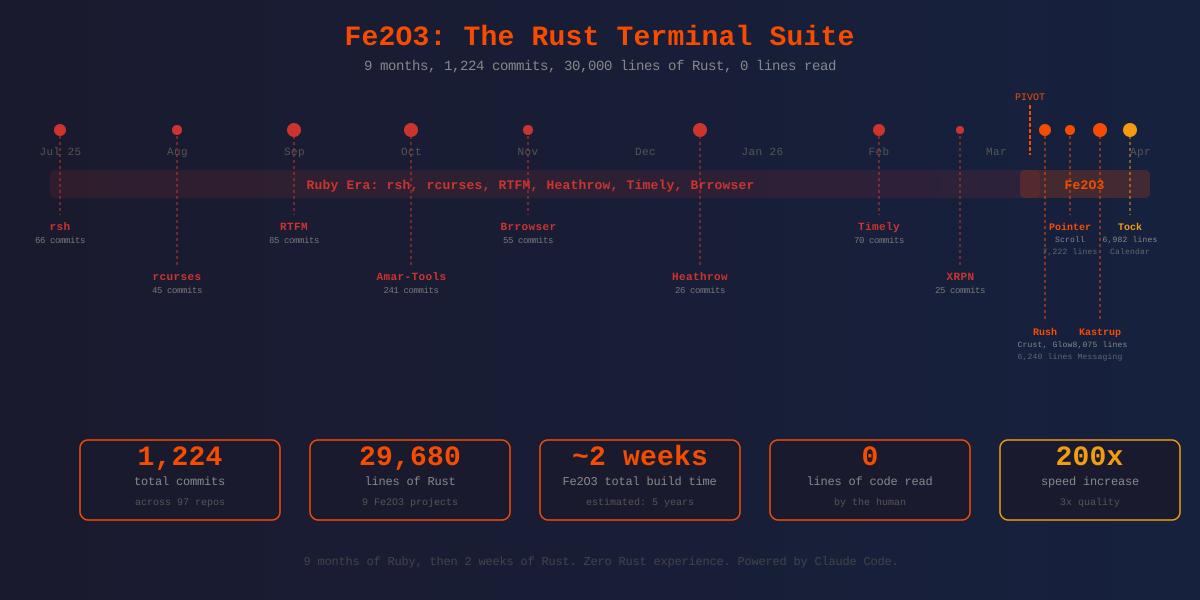
The project is called Fe2O3, the chemical formula for rust (iron oxide). Nine projects, each a complete rewrite:
| Rust App | Clone of | Lines | Binary | What It Does |
|---|---|---|---|---|
| Rush | rsh | 4,279 | 2.6 MB | Interactive shell |
| Crush | - | 517 | 789 KB | Shell config helper |
| Pointer | RTFM | 4,628 | 3.7 MB | File manager |
| Scroll | Brrowser | 2,594 | 4.9 MB | Web browser |
| Kastrup | Heathrow | 8,075 | 7.5 MB | Messaging hub |
| Tock | Timely | 6,982 | 7.0 MB | Calendar |
| Crust | rcurses | 1,524 | (lib) | TUI library |
| Glow | termpix | 437 | (lib) | Terminal image display |
| Plot | Termgraph | 713 | (lib) | Terminal plotting |
Every application is a single static binary. No runtime dependencies, gems or interpreters. Just download and run.
How We Work
I describe what I want in plain language. I show screenshots. I compare with the Ruby version side by side. Claude writes the code, compiles it, fixes errors, and iterates. When something looks wrong, I take a screenshot and paste it. When a feature is missing, I describe it. When the behavior differs from the original, I say “make it match.”
I never look at the source code because I don’t need to.
This sounds reckless. It’s not. Claude writes cleaner code than I ever did. My bug rate has gone from about one reported bug every three months to roughly one per nine months, while the feature set has grown substantially.
The bottleneck is imagination, not the coding.
The Ruby to Rust Surprise
The smoothest part of this journey was the part I expected to be hardest. Converting Ruby to Rust means converting a dynamically typed, garbage-collected, interpreted language to a statically typed, ownership-tracked, compiled one. Every Ruby idiom needs rethinking.
But Claude doesn’t “convert.” It understands what the Ruby code does, then implements the same behavior idiomatically in Rust. The Rust code doesn’t look like translated Ruby. It looks like native Rust written by someone who thinks in Rust… I believe. Remember, I haven’t read the code - but someone snitched.
The Crust TUI library is a good example. The Ruby rcurses uses string extensions (.fg(196), .bg(0), .b for bold). Crust uses module functions (style::fg(text, 196), style::bold(text)). Different idiom, same result. And when rcurses uses specific SGR reset codes to allow chaining (.b.u.fg(232).bg(246)), Crust now does the same, so the layering works identically. It took me years of manual coding to get rcurses right. It took a few hours to make it rust.
The Tock calendar was the finale. It includes a complete planetary ephemeris engine ported from my ruby-ephemeris library. Keplerian orbital elements, perturbation corrections for Jupiter and Saturn, topocentric parallax. The Rust version computes planet positions, sunrise/sunset, moon phase, and moon rise/set times. All in pure Rust, no external dependencies. The full conversion from Timely with some functions added, took about one hour.
The Estimation Problem
When Claude estimated five years for Fe2O3, it was being perfectly reasonable. A single developer learning Rust from scratch, porting six complex applications with TUI frameworks, image protocols, SQLite databases, OAuth2 integrations, MIME parsers, ephemeris calculations, and weather APIs? Five years is honest.
But Claude estimated based on its training data, which reflects how humans work. It estimated the time for a human to do this. What it didn’t factor in is that it’s not a human doing the work. It’s a human and an AI working together, where the AI writes 100% of the code at machine speed and the human directs with ideas, screenshots, and “make it match.”
The five-year estimate was correct for the old paradigm. We’re not in the old paradigm anymore.
The Broader Picture
Beyond Fe2O3, the nine months include:
- 241 commits on Amar-Tools (an Amar RPG tool set)
- 85 commits on RTFM (continuous improvement, never read a line)
- 70 commits on Timely (built from scratch, then kept evolving)
- 66 commits on rsh (major features: job control, command substitution, functions)
- 55 commits on Brrowser (built in 2 hours, then 55 iterations)
- 45 commits on rcurses (foundation library, continuously refined)
- 26 commits on my blog
- 25 commits on XRPN (my RPN programming language)
Across 97 repositories. In nine months. Without reading code.
SI: Superintelligence
Maybe superintelligence is something that would arrive someday, where AI wakes up and is smarter than all humans combined.
But I think differently about this now. It seems to come in a different form.
Superintelligence may not be a solo AI. It can be a combination. A human who has spent 40 years building mental models of what software should do, paired with an AI that can write any code in any language at any scale. The human provides vision, taste, and judgment. The AI provides execution at superhuman speed and breadth.
Neither alone is superintelligent. Together, we are.
I can’t write Rust. Claude can’t decide what’s worth building. Together, we produced 30,000 lines of Rust across nine applications in two weeks, with better quality than I achieved in decades of manual programming.
The question is no longer “what can I build?” It’s “what should I build?”
That’s a much better question.
As a final note: While we can debate how software meant for business operations should be developed and shipped, I fully expect my software popularity to slowly die after people discover how easy it is to create the perfect tools tailored to their own needs. You don’t have to install and run the software that most closely fit your need, or clone it and tweak it manually to suit your fancy. No more hoping for the features you’d like to see or submit a Pull Request that you hope will be included in your favorite app. You can simply create your perfect software from scratch with Claude Code today.
Link to this post: https://isene.org/2026/04/SI.html