
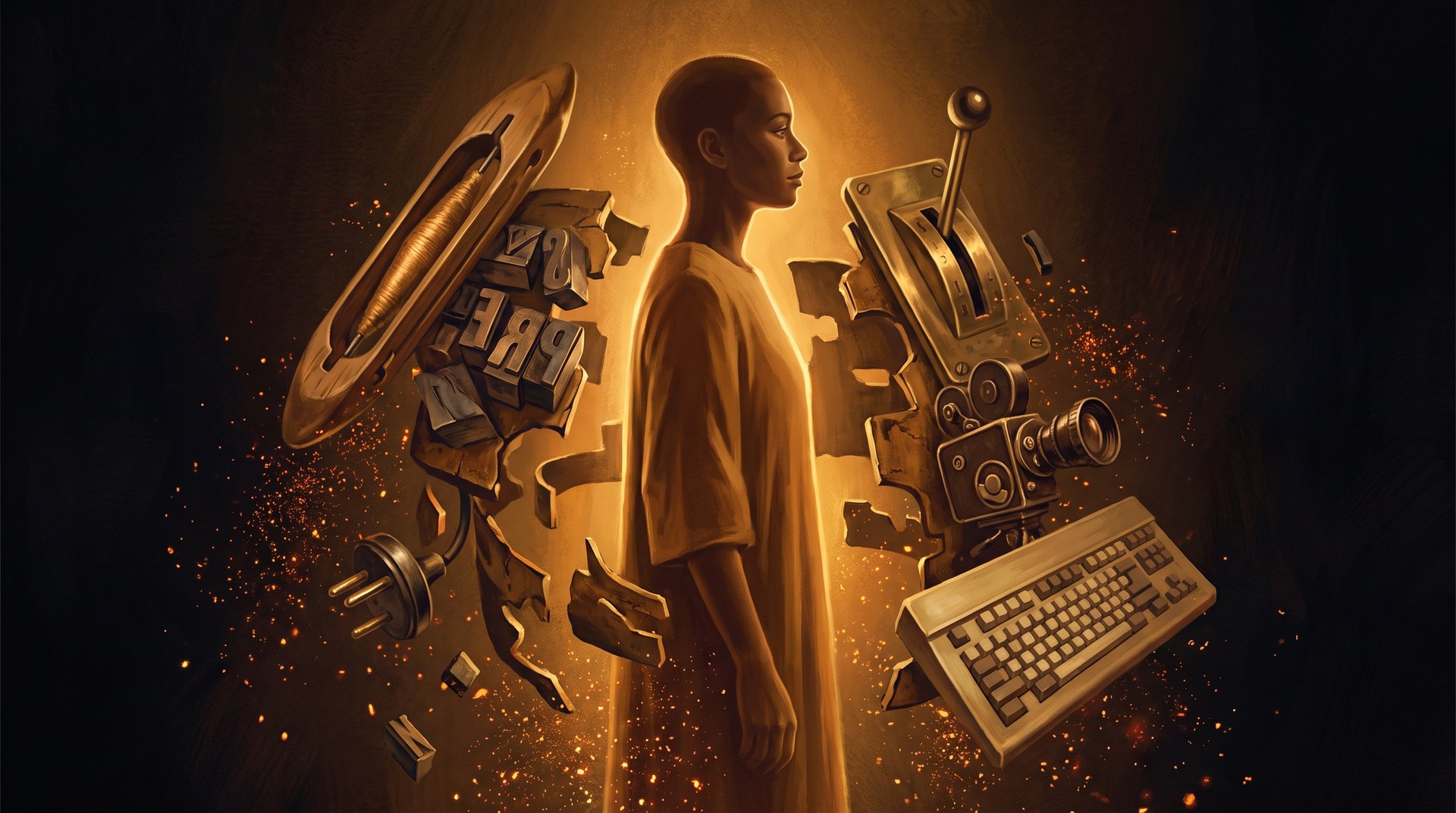
When you read TEG (Trans-Existential Grounding), you will see that the biggest trap of a person is identification.
When you identify with something, you equate yourself to that something to a greater or lesser degree.
When that something is attacked, hurt, diminished or gone, that has a direct impact on you.
When a woman has spent her whole life building the identity of a ballet dancer and is forced to retire at 42, the loss of identity can be tough.
An identification can be to anything; a trade or profession, a place, a religion or political movement, a cause, other people. Anything.
The basic identifications are to one’s body, name, reputation, family. The close stuff of life.
A skill or profession is often close. It hurts when that gets a hit.
Like with the advent of the automated looms, weaving machines. The legend has it that Ned Ludd smashed two stocking frames in 1779.
The Luddite uprising began in 1811, starting in Nottinghamshire, England. Textile workers began smashing stocking frames and other machinery they saw as threatening their jobs and wages. They said they were following “King Ludd”. The movement spread to Yorkshire and Lancashire and peaked in 1812 before being suppressed by mass trials and executions, fading out by around 1816–1817.
Not only their livelihood was threatened. Their identity got a hit.
There are plenty of historical examples of the same;
- farm workers smashing threshing machines in the Swing Riots (1830)
- the Red Flag Act against motor vehicles (1865)
- the Linotype challenging hand typesetting from 1886
- streetcar and stagecoach drivers vs. buses and cars (1900s - 20s)
- automatic telephone exchanges (1890s - 1930s)
- morse operators fought automated telegraphy (1920s - 30s)
- elevator operators (1940s–50s) where unions struck against self-service elevators
- introduction of shipping containers in the 1960s
- musicians vs. “canned music” (1920s - 40s) where musicians fought sound film and jukeboxes, and struck for two years over records
- synthesizers and drum machines (1980s). The UK Musicians’ Union tried to ban synths from sessions and broadcasts
- bank tellers vs. ATMs (1970s–80s)
- photographers vs. digital cameras and Photoshop (1990s–2000s)
- self-checkout backlash (2000s–present)
AI follows suit.
There are real concerns of loss of livelihood, although history has shown a steady increase in employment, so that part usually sorts itself out.
There is also the constant damage to people’s skill, trade and hence identity.
In the current anti-AI sentiments among software developers, most devs don’t see their livelihood threatened. They see their identity attacked.
When you tie your identity to a way of doing things, you are in for a very bumpy ride. If you focus less on the process and more on the outcome, then the AI wave is more of a boost.
My own productivity as a developer has increased between 40x and 60x and the quality of the code is somewhere in the 10x to 20x counting in the number of reported bugs per user per amount of code. I used to code by hand and keyboard. A lot. Since the summer of 2025 I have not looked at the code I have produced with Claude Code. With the Quantity x Quality score averaging in the hundreds, I don’t need to.
My commits on GitHub, per year:
| Year | Commits | Repos touched |
|---|---|---|
| 2022 | 126 | 9 |
| 2023 | 165 | 11 |
| 2024 | 158 | 34 |
| 2025 | 408 | 25 |
| 2026 | 3,125 | 104 |
2026 is only nine months in. 163 repos, 81 of them started this year: a terminal suite in Rust, Linux tools in pure x86 assembly, a game engine and more.
Then again, I’m not concerned about my identity. I don’t care about praise, approval or cred. I care about outcomes. And when people complain about code quality or AI making mistakes, as if humans don’t, then it is mostly arguments masking the identity hit they feel. Same with musicians in the age of AI. And many more professions will follow.
As long as you can let go of your identities, you’ll be fine.