
I started programming when I was 13. Basic, then lots of work in FOCAL on the HP-41 calculator, then OPL, Pascal, MCODE, Assembly, Visual Basic, Ruby, Fortran, Python, Forth and more obscure languages. Lately with the use of Claude Code it’s been a massive amount of Rust and Assembly.
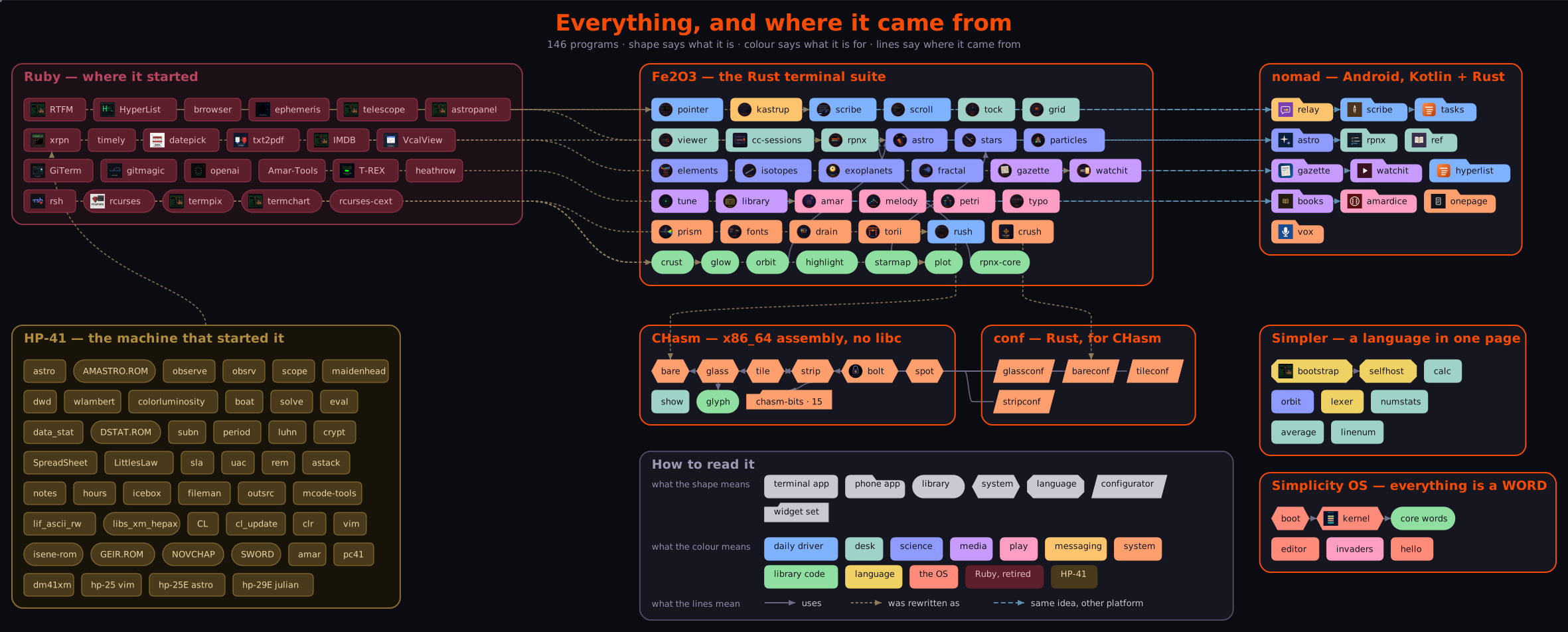
I’m starting to lose track of it all, and being a somewhat visual guy, I decided to make a map of most of my programming projects. There are more fringe projects also, but here are the main ones: 146 programs. Seven shelves. In one map.
Click it for the full size. The arrows move, and they move the way they point.
What the shelves are
HP-41 is where the line starts. Programs, ROMs and the tools around them for a calculator from 1979, plus the other machines that came with it.
Ruby is the first shelf on a computer. Twenty-three gems, and ten of them have a descendant somewhere else on the map.
Fe₂O₃ is the Rust terminal suite as it stands: 30 apps, seven libraries and the four configurators, which sit in their own group because they configure something that is not Rust at all.
CHasm is that something. A shell, a terminal emulator, a window manager, a status bar, a pager, a font rasteriser, a screen locker, presenter tools and fifteen tiny status widgets. All of it in x86_64 assembly, with no libc.
nomad is the phone. Thirteen Android apps, most of them the desktop tool again in a different shape.
Simpler is a programming language small enough to hold in a prompt, and it compiles itself.
Simplicity OS is bare metal, where everything is a WORD. Inspired by Forth.
What the lines say
Three kinds.
Dotted amber: was rewritten as. rsh became rush became bare. The shell has been written three times: Ruby, Rust, assembly. Each one faster and smaller than the last.
rcurses became crust, RTFM became pointer, termpix became glow, termchart became plot, astropanel became astro. And xrpn, an HP-41 in Ruby, became rpnx.
Dashed blue: the same idea, other platform. Nine of them, all between Fe₂O₃ and the phone.
Solid grey: uses. The libraries and the four configurators, each reaching across to the assembly tool it sets up.
The shape of it
Nothing on this map was planned as a map. Every one of those programs was an itch that I scratched. The pattern only shows up afterwards: the same tools keep getting rebuilt, one layer closer to the metal, and the ideas keep crossing to whatever machine is in my hand.
That is decades of scratching, in one screen.
Summary
The map is drawn by a small program, so it can be redrawn whenever a shelf grows. The logos come straight from the app repos. Shape says what a thing is, colour says what it is for, and the arrows say where it came from.
Link to this post: https://isene.org/2026/08/Map.html